Showing posts with label dinosaur. Show all posts

Friday, 6 December 2013

John Conway's Glorious Beasties

I've been a fan of John Conway's work ever since I first discovered him on Darren Naish's Tetrablog for Scientific American and his Tetzoo podcast. Conway's work is both accurate and tongue-in-cheek; he'll give the same level of care to depicting a Styracosaurus as he will to a wholly unproven cryptid like Bigfoot. And his paintings are beautiful. Just look:


They were Giraffatitan, Megalodon and Yeti. Aren't they great? He also produces some lovely fantasy artwork too:


Now, as you'll know if you've seen my live talks or read this blog occasionally, I am a bit of a dino-nut. I freakin' love prehistoric beasties. Which is why I like Conway's work so much. These aren't depictions of statues, these are living, dynamic animals who hunt and fight and shag and roll in the mud for fun. So, if you like his work as much as I do, there are prints and books available on his website here.

And here are a couple of my past blog posts you may like: The story of how I helped make a new tail for one of the world's most famous dinos here; and a post on dinosaur books and the evolution of palaeoart here.

Wednesday, 10 July 2013

Tyrannosaurus Bling

Wow.


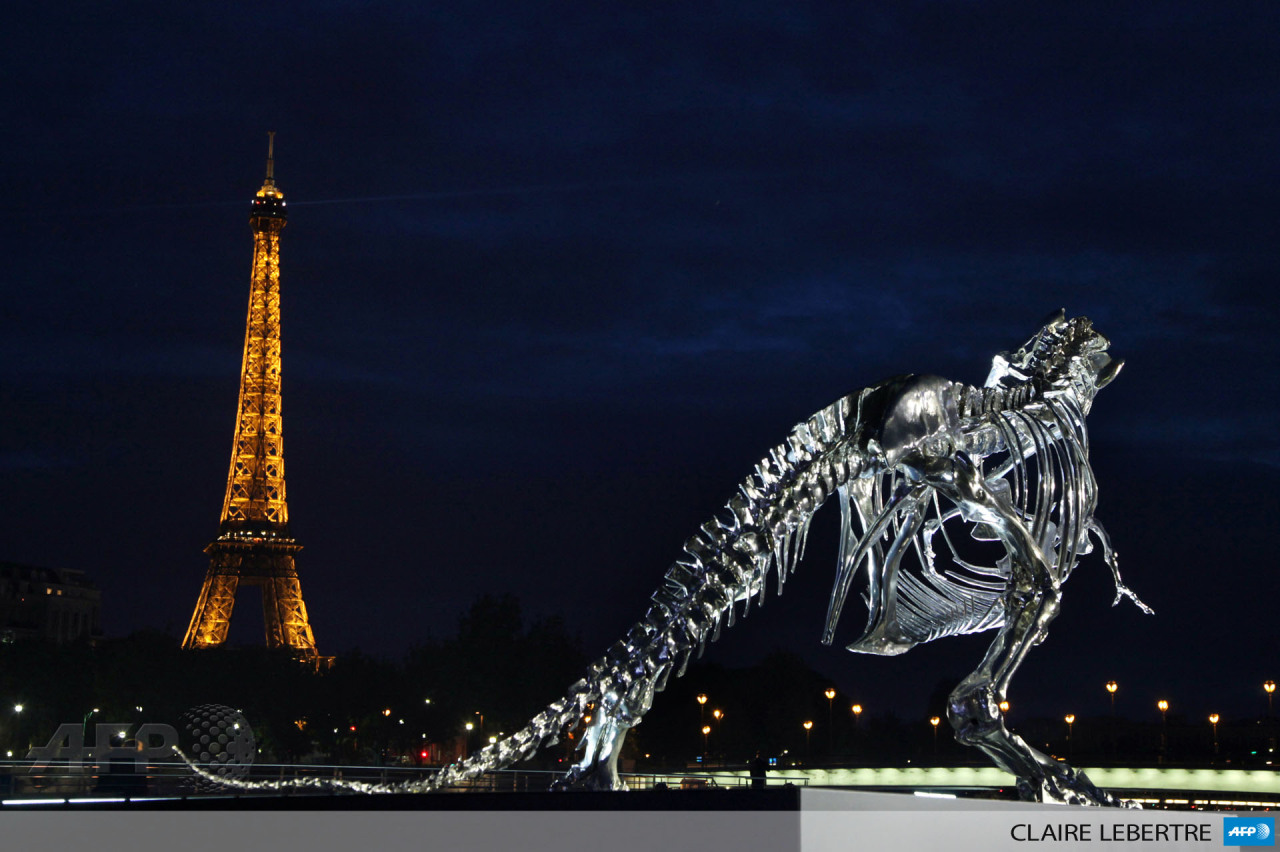
Artist Philippe Pasqua has installed an impressive T Rex skeleton by the Seine in Paris. The dino is made from 350 chrome moulded bones and measures a full 21′ x 12′.

Wow.

Giant Chrome T Rex Installed on the Seine River in Paris by Philippe Pasqua sculpture Paris dinosaurs bones
 
Giant Chrome T Rex Installed on the Seine River in Paris by Philippe Pasqua sculpture Paris dinosaurs bones
 
Giant Chrome T Rex Installed on the Seine River in Paris by Philippe Pasqua sculpture Paris dinosaurs bones
Photos by Anthony Gelot
 
Via This Is Colossal

Where have all the monsters gone?

Remember this?

 
Or this?


Seen much of Nessie recently? Nope, nor me.

I was lucky enough recently to chat to the extraordinary Colonel John Blashford-Snell, explorer, inventor of white water rafting and Operation Raleigh, and Honorary Life President of the Centre for Fortean Zoology. John has travelled all over the world in search of cryptids and has been successful in finding the fabled Andean double-nosed dog and the almost legendary giant elephants of Bardia, Nepal. He even had a go at finding Nessie a few times, including one using sonar aboard an airship floating slowly over the loch, but he didn't find the monster. We didn't have time to discuss it in any detail and he had no firm conviction as to its existence but it did set me off wondering ... where have all the monsters gone?


By coincidence, this cartoon panel appeared on the always excellent XKCD webcomic site. And it's true isn't it? Once upon a time there was a proliferation of fuzzy, indistinct photographs of UFOs, lake monsters, ghosts, yetis, sasquatches and bigfeet, and bug-eyed greys. And you can understand why; cameras were awkward, bulky. You had to load film into them and set f-stops and shutter speeds. And you had to focus the damn thing. It's amazing anyone ever got a photo at all. But, these days, we nearly all have point and click, autofocussing hi-resolution digital cameras and we all carry them around with us. They're even built into our phones, laptops and tablets. So there should be hundreds of new Nessie photos every year. And that's not counting CCTV, webcams and satellites photographing every inch of the loch from space. If Google Earth can get pics of Loch Ness like this ...


... pics so close that you can actually see the ripples on the surface ...


... why can't it capture a dirty great monster? Or monsters. After all, it's unlikely that Nessie, if she exists, is a lone example of her species. There must be a breeding population of these things.

The oldest possible 'sighting' of Nessie goes back to St Columba in 565CE who went out on the loch to admonish a 'water beast' that had killed a fisherman. Even assuming there was only a breeding pair there at the time, you'd have a pretty sizeable population by now, some 1,400+ years later. And even if that population had been denuded by pollution or changes in environment, those changes have happened only in the last 300 years, so the loch should have been swarming with the wee buggers in the centuries beforehand. To add to the weight of evidence against, we must also take into account that the most common theory about Nessie is that she's a 'living fossil'; a plesiosaur or some other long-necked animal that we only know of through the fossil record. As far as we know, the last of the plesiosaurs died out, along with their cousins the dinosaurs and pterosaurs, during the K-Pg Extinction Event. So, if a few survived and bred, they've had 65 million years to breed and multiply. Wouldn't the loch be teeming with them now? And surely they would have spread out? Loch Ness does connect to the sea and there's lots more food out there than there is in the loch.


Now, I realise that some people will point to the coelacanth, a bony-limbed fish that we believed extinct for 65 million years that turned up, alive and well, in 1938 and say, 'Aha!' But the coelacanth is a deep water fish whereas the sea reptiles were air breathers like whales and seals and had to keep returning to the surface. Surely there would be more than just a few odd, poorly described or recorded sightings?

Nope, the sad fact is that much as I desperately want there to be living prehistoric animals, all the evidence - or lack of it - amounts to a big fat nothing. Even with brilliant photoshoppers out there, no good photos - allegedly real or outright fake - have turned up in ages. And it's not as if the public's interest has waned - you only have to look at the press response to James May's Skegness monster hoax in 2012 to see that.


But let's not give up hope eh? We're discovering new species every year, some that we'd thought long extinct. Who knows what may turn up? Sadly, I doubt it'll be a plesiosaur. It's more likely to be something small-ish like the recently discovered Lord Howe's Stick Insect, one of the largest insects on the planet and believed extinct since 1930 ... until a small population turned up in 2001 living under a single shrub on the small islet of Ball's Pyramid, the world's tallest and most isolated sea stack.

Now, don't get me started on UFOs and little green men ...

Wednesday, 3 April 2013

Bone 37: The Tale of a Dinosaur's Tail (Revisited)

I first posted some of this story back in 2010 on my old blog. I figured it was time for an update. So I've re-written and expanded it to bring it bang up-to-date ...

If you visit London's famous Natural History Museum almost the first person or thing you come face to face with is Dippy the Diplodocus.


'Dippy', I should explain, is the nickname of one the museum's oldest and most impressive residents. It's the massive black skeleton of a Diplodocus that dominates the main hall. Dippy isn't actually a true fossil; she's a casting made from plaster, coal dust and paint and she's been at the NHM since May 12th 1905. She's also a bit of a jigsaw having been made from parts of five unrelated Diplodocus skeletons. The original, if you can call it that, is in the Carnegie Museum in Pittsburgh, Pennsylvania. Other copies are displayed all over Europe and South America making Dippy probably the most visited dinosaur skeleton(s) in history.


I'm often at the NHM and, recently, have been there a lot - especially when Dan Schreiber and I were writing the live Museum of Curiosity show that we staged in Dippy's hall last Autumn (see here). Whenever I do visit, I always say hello to Dippy. And as I get to her long, sinuous tail I usually stop and look up and count the bones starting from the tip. The bones here are small, the size and shape of cocktail sausages, but they soon start to get bigger. By the time I pass Bone 30, they are the thickness of a grown man's arm. And then I reach Bone 37. It's a very special bone for me. And that's because I made it. Here it is:


It's quite humbling to walk along the length of this creature - all 105 feet of it - and realise that it was not, by any measure, the largest of the dinosaurs. Some of its cousins, such as the extraordinary Amphicoelias, may have been close to twice as long - and maybe the largest animal to have ever lived. Just to give you some idea, the Diplodocus is the green dino in this diagram. Amphicoelias is the red. Compare the size of the 6 feet tall human at bottom left.


For almost all of her afterlife, Dippy was displayed with her long tail dragging along the ground. Look in any dinosaur book published prior to around 1985 and that's what you'll see. Here's the wonderful Zdenek Burian's famous version:


When I was a kid, the dinosaur books told us that these huge sauropods couldn't even support their own body weight and lived in lakes (another Burian painting).


But that's the nature of studying dinosaurs; all of the fossils we have represent just a tiny, tiny window on their world. We probably will never get to see 95% of the species that existed back then. Therefore each new discovery sheds some new light. In just the past couple of decades, we've seen them change from lumbering, cold-blooded beasts into dynamic predators and herders, and we've found enough evidence to be pretty sure that modern birds are dinosaurs that survived the mass extinction event 65,000,000 years ago. Last year we even found dinosaur feathers trapped in amber. We've also brought the sauropods out of the swamps and lakes and lifted their tails off the ground. Dippy needed to do the same.

And so, in 1993, the NHM decided to raise Dippy's tail; no mean feat considering how many plaster bones were involved. In fact, the weight of the tail made it impossible and so a very good friend of mine, model maker and film special effects expert John Coppinger (website here), was given the job of moulding and recasting every single one in lightweight fibreglass and carbon fibre. John was, for many years, a model maker at the museum before moving into film. He was the man who sculpted Jabba the Hutt for Star Wars: Return of the Jedi and many of the creatures in Luc Besson's The Fifth Element and the Harry Potter films. This, however, was a massive undertaking. I'm not sure exactly how many bones there were involved but they all had to be moulded, cast, fettled, painted and 'weathered' to match the rest of the existing skeleton. The largest bones, nearest the hips, were as tall as me. John was happy to accept some help from friends and colleagues, myself included. Here's a picture of another helper, Will, with just some of the smaller bones.


This picture below shows John (right) and the late and much missed Roy Hale (Left) mounting the new bones onto a rod that, to this day still supports the tail along with specially designed stand and a cable suspended from the high roof.


For my small part, I was involved in the making of about six or seven bones but Bone 37 was all mine. It was a very special project to be involved in and I look back on it with nothing but fond memories despite the resin fumes and endless repetition. And to help me to remember I have this most precious thing:


Yes, it's the original 105 year old Bone 37. The originals were so old and so fragile that many didn't survive the moulding process. The museum staff were prepared for that; it was a price they knew they'd have to pay. But at least the new fibreglass bones would be exact replicas and the moulds would allow future castings to be taken. Bone 37 did lose a chunk off one of its processes but survived its ordeal pretty well. And to my delight, the museum staff said that I could keep it. It's one of my proudest, if dullest, possessions. And, just recently, I took it back to the NHM to meet Dippy, 20 years since her tail was lifted. Here she is, reunited.


If I ever decide to do Mastermind, the closest thing I'll ever have to a specialist subject is dinosaurs. I love those beautiful great brutes, always have done and always will. As an 11 year old kid I came up to London from Cornwall on a school trip and my abiding memory of the event is being stunned, shocked and captivated by Dippy the Diplodocus. She inspired a life long interest in me. So it's nice to think that, in some small, tiny, glass-reinforced plastic way, I've helped Dippy to go on inspiring people into the 21st century.


Thursday, 17 January 2013

Let me see you shake your tail feather

We've known for some time now that dinosaurs had feathers and that the theropod dinosaurs were the ancestors of modern birds. The proof is quite overwhelming - particularly the large number of feathered dinosaur fossils found in recent years in China. And then, last year, the first dino-feathers trapped in amber were discovered near Grassy Lake in Alberta - dating from the Late Cretaceous period. And they told a fascinating story.


"We're finding two ends of the evolutionary development that had been proposed for feathers trapped in the same amber deposit," said Ryan McKellar of the University of Alberta. The team's find confirms that individual filaments progressed to tufts of filaments from a single origin, called barbs. In later development, some of these barbs can coalesce into a central branch called a rachis. As the structure develops further, further branches of filments form from the rachis. "We've got feathers that look to be little filamentous hair-like feathers, we've got the same filaments bound together in clumps, and then we've got a series that are for all intents and purposes identical to modern feathers," says Mr McKellar. "We're catching some that look to be dinosaur feathers and another set that are pretty much dead ringers for modern birds."


We also now know that feathers appeared much earlier in dinosaur evolution than first thought. Fossils of Ornithomimus edmontonicus - which looked something like ostriches but were not previously known to have feathers - have recently been found to have hundreds of traces of filaments along the body and limbs. Moreover, as the team reported in Science, while one of the two adult skeletons showed evidence of possessing a pennibrachium = a forelimb bearing long feathers that form a winglike surface - the third specimen, a juvenile dinosaur about 1-year-old, lacked this structure, although it still had numerous feathers along its body. This marks the first time that wings and feathers have been identified in ornithomimosaurs. "Our specimens are currently the most primitive dinosaur to show winglike structures," says Dr Darla Zelenitsky, a geoscientist at the University of Calgary in Canada, "And because ornithomimosaurs were fairly large, weighing 150 kilograms or more, these earliest wings did not initially evolve for flight - they were obviously not flyers or gliders. Moreover, O. edmontonicus does not appear to have developed its full plumage until it reached the adult stage, which suggests that the wings and feathers served some sort of adult reproductive function such as courtship and brooding."

Meanwhile, another study of a 150 million year old dinosaur fossil has revealed it had multi-coloured feathers. The research, published in the journal Science, compared the structures which determine colour in living bird feathers with those in the fossil. "This would be a very striking animal if it was alive today," said Yale University's Professor Richard Prum, co-author of the report. It is believed the colours would have helped the dinosaur attract a mate. Anchiornis huxleyi is a four-winged dinosaur which lived in the late Jurassic Period in China. Researchers chose this particular fossil to work on because the feathers were so well preserved.


And why shouldn't dinosaurs have been colourful beasts? Just look at modern birds, reptiles and amphibians. But, more than that, look at how dynamic our modern animals are. Doesn't it seem likely that dinosaurs were just as active in their competition, mating and sexual attraction displays?

Well, another recent study suggests proof of exctly that. In an issue of the journal Acta Palaeontologica Polonica, three paleontologists posit that fossilised oviraptors possessed structural features that are characteristic of those found in modern birds with ornamental tails. For example, in the early oviraptor Similicaudipteryx, the last caudal vertebrae (the tip of the “tailbone”) are fused into a structure known as a “pygostyle," which was long thought to be a feature exclusive to modern birds. There is no evidence that Similicaudipteryx was a flying species, and the authors suggest that the bone and muscle structures that can be discerned from the fossil remains are consistent with those seen in birds with tail displays that don't aid in flying but do functional as flashy ornaments, such as peacocks, turkeys, and birds of paradise (note that these birds are not completely flightless, the tails just don't contribute to optimal flight). Some species do indeed favour form over function, and apparently the trend may have started way back in the Mesozoic.


These assertions are, of course, subject to scepticism due to the limitations of the fossil record. This is part of science - publishing new perspectives or conclusions and allowing the scientific community to contribute further analyses and information, ultimately either supporting or discarding the idea. What is unquestionable, however, is that this paper signifies just how far palaeontology has come in recent years. New finds and new technology have yielded broader and deeper information about the details of what dinosaurs actually looked like, how they moved, and how they might have interacted in their ancient world.

Sources:

SciLogs
ScienceMag
BBC News
BBC Science

Saturday, 13 October 2012

An open letter to Jasmin H

I'm sure, by now, that you've seen the letter below, penned by Jasmin H, a home-schooled 14-year-old from Scargill in New Zealand, and published in the October 3rd edition of The Northern Outlook:


I decided that, rather than ridicule her as so many websites are doing - it's probably not her fault, people, and she's 14 - I'd write her letter:

Hi Jasmin

I read your letter in the newspaper and decided that I would write a letter to you. I should start by saying that I'm not homosexual and I have no agenda in writing this letter. I'm a married man, an ex-cop in his 50's, with three grown up kids in their 20s. Nor am I anti-religion (though I have no faith myself) and would never belittle your beliefs if you have any. I won't be impolite or, in any way, rude or bullying. You're obviously a smart young lady and feel strongly enough and well-informed enough to write letters to newspapers. All I'm asking you to do is read this letter and look at a few sources of information that maybe you haven't seen before. I hope that's okay.

I was a little bit confused by your letter. You say in your final paragraph that you don't believe in evolution. I wonder why that is, considering the weight of evidence for it. If, as I suspect, you are a person of faith, there is no reason why your faith and evolution have to be mutually incompatible. After all, the Catholic church and the Church of England and many other branches of Christianity accept evolution as fact. They simply argue that God created the process. I can't prove that they're wrong! You obviously know something about the subject because, throughout the letter, you talk about evolution as if it does exist, using phrases like 'our level of intelligence should have evolved somewhat' and 'if homosexuality spreads, it can cause human evolution to come to a standstill' and 'the ducks will have evolved further than we have'. Perhaps you're more undecided, rather than disbelieving? I'd like to think that you have an open mind.

Incidentally, you might be interested to know that ducks have been around for a very long time; the fossil record suggests that they were around during the age of dinosaurs - or at least their ancestors were.

 
That's an artist's impression of a species called Vegavis, which belonged to an order of birds called Anserifomes, which includes waterfowl. Within this order, Vegavis is most closely related to true ducks and geese of the family Anatidae. Vegavis fossils have been found in Cretaceous rocks 65 million years old.

Julia Clarke of North Carolina State University used computer tomography (CT) scans to get a good view of the rock-encased fossil and concluded that the partial skeleton was a new species and very important to the story of avian evolution. "We now know that duck and chicken relatives coexisted with dinosaurs", she says. "This does not mean that today's chicken and duck species lived with dinosaurs, but that the evolutionary lineages leading to today's chicken and duck species did." Clarke's findings provide proof that cousins of living bird species co-existed with dinosaurs. Before the classification of Vegavis, the fossil record of living bird lineages in the Cretaceous period was very unreliable.

Ducks have been around a great deal longer than humans ... they've had more than a 60 million year head start on us. But, despite this advantage, I'd argue that they're not really more advanced  than we are. Yes, they pair up and nest together but don't most humans do that too? And we have marriage - a consciously made commitment between two people who love each other, whatever their genders happen to be. Ducks only have a primal instinct to pair bond. It really isn't a valid comparison as things differ from species to species.

And you might be surprised to learn that ducks engage in homosexual behaviour too; about one in 10 mallard couples are homosexual, which isn't too far off the figures for humans. Ducks also regularly indulge in 'attempted rape flights' when they pursue other ducks with a view to forcible mating. They also engage in necrophiliac homosexual behaviour (see here). So I'm not entirely convinced that they are a good role model for us humans; by comparison, two people loving and caring for each other is surely a vast improvement!

You also say that, after 2000 years, we should be cleverer than our ancestors but the reality is that you and I are no cleverer than the Romans were. There's been no significant development in human brains in just two millennia. People aren't cleverer today; they simply have access to more information. I couldn't build the Colosseum. Could you? And yet someone did built it all those years ago without books or the Internet. I know more than my grandfather did because I have instant access to almost the whole of human knowledge, but I'm no smarter than my grandad. I'm certainly not smarter than original thinkers like Leonardo da Vinci or Isambard Kingdom Brunel or James Watt or Isaac Newton; imagine what they might have achieved if they'd been able to Google! Da Vinci had ideas about flight hundreds of years ahead of his time; if he'd have been able to talk to other flight pioneers around the world by Skype or email or Twitter, we'd have had jet planes by the 17th century. Knowledge is a wonderful, wonderful thing.

And the most wonderful thing about knowledge is that it's available to us all unless it's deliberately withheld. The greatest gift you can give a child is a sense of wonder and an enquiring mind. Out there, right now, are 14 year olds like you who will one day cure cancer and put humans on Mars and alleviate poverty and suffering. And they will do all that by learning; by reading as much as they can and making reasoned and intelligent choices about what to believe based upon the weight of evidence. I hope that you will do the same, Jasmin. I hope that you will never let closed-minded people with blinkered views deny you the opportunity to achieve whatever you are capable of achieving. Ignorance, in its true sense of 'lacking knowledge', really isn't bliss at all.

I also hope that you'll come to see that it's not a sin to love someone, or to want to spend your life with someone, who just happens to be the same gender. Homosexuality isn't a disease or an illness; it won't 'spread' as you suggest. You can't catch a dose of Gay. It's been around as long as humans have been around - there just seems to be more of it these days because society is becoming more enlightened and less intolerant. People can come out more openly than ever before. The children of gay couples don't automatically become gay themselves and many heterosexual couples choose not to have children.

We are all born gay or straight or bisexual. We can no more choose who we fall in love with than a duck can choose to lay square eggs. Do you have any gay friends? How would you feel if your best friend or one of your relations 'came out'? It wouldn't stop them being the person they always were, would it?

If we all want to live in a peaceful society free from fear, persecution, prejudice and harm, then the foundation stones we need to set in place are knowledge and mutual respect. We should all strive to be less judgemental. In an ideal world, we should all make the effort to understand each other and ensure that we never treat others in ways that we ourselves wouldn't want to be treated.

THAT's enlightenment.

Warm wishes

S
x

P.S. If this all turns out to be a practical joke or a 'Poe', ignore everything I've said, okay?
 

Sources: Live Science, 600 Co  
 

Thursday, 4 October 2012

Tinysaurus Cutenex

A new dinosaur has been discovered in South Africa that is quite tiny and quite odd. In a report published yesterday in the online journal ZooKeys, Paul C. Sereno, a palaeontologist at the University of Chicago and a dinosaur specialist, described the strange anatomy of the newfound member of the heterodontosaur family and gave the new species the name Pegomastax africanus, or “thick jaw from Africa.” He also apologised in an interview for not getting around sooner to this piece of research. The rock containing the fossil was original found in the 1960s.

Embedded in the rock were remains of a creature with a short parrotlike beak, one-inch jaws, sharp teeth and a skull no less than three inches long. The entire body was less than two feet in length and probably weighed less than a small house cat.


Pegomastax is a species of Heterodontosaur, early ancestors of the larger, more familiar dinosaurs that came later.


Cute eh? Read the whole story here.

Thursday, 28 June 2012

I'll never eat a whole wing ...

An extraordinary fossil has turned up in Australia. The primitive bird (it still had teeth) Pelagornis lived around 5 million years ago and is believed to have been one of the largest, if not the largest, bird ever to fly. Its wingspan was a staggering 6 metres. That's just short of 20 feet. Or, if you want a visual, about the same as the height of a fully-grown giraffe. Here's an artist's reconstruction:


I've also shown it alongside a reconstruction of a Hatzegopteryx just to give you an idea of how big the prehistoric pterosaurs could get. Here's another Hatzegopteryx along with its cousin the better-known Quetzacoatlus:


To think that I used to be impressed by the sight of a heron or a swan in flight. These guys make everything we have today seem kind-of tame, don't they?

Tuesday, 15 May 2012

DON'T call him 'Chicken'

Feathered dinosaur discovered in China - Yutyrannus huali
Yutyrannus huali is a newly-discovered early Cretaceous dinosaur from the rich Chinese fossil beds. He is the great granddaddy of Tyrannosaurus rex and could well have handled himself, don't you think?; Credit: Brian Choo

When the dinosaur groups first evolved feathers, we have seen many Chinese examples of small chicken-like reptiles from Cretaceous and Jurassic times. Now, like a rampant bus charging through the ancient records, we have a one and a half ton giant with stubbly feathers. No way could this beast flop through the air.

He's a tyrannosauroid with one large and two small very complete fossils, again from Liaoning Province in China. The specimens are 125 million years old, almost twice the age of the Tyrannosaur dynasty. That means they are ancestral, basal tyrannosaurids! With three fingers on huge feet, the feathers are long and filamentous on its back.

The name given is Yutysaurus huali, meaning he is a beautiful feathered tyrant. Xing Xu, Kebai Wang, Ke Zhang, Qingyu Ma, Lida Xing, Corwin Sullivan, Dongyu Hu, Shuqing Cheng & Shuo Wang decided to name him as such in the current publication of the journal Nature. They hail from Shenyang and Beijing Universities, University of Alberta and the Zhucheng Dinosaur Museum in Shandong.

Tail section fossil of Yutyrannus huali
Tail section fossil of Yutyrannus huali; Credit: Mr ZANG Hailong

The fossil beds in Liaoning are rich, with Beipiaosaurus the biggest feathered relative found so far. Yuty comes in at 40X the mass of that previous record-holder, becoming the largest feathered dinosaur species discovered to date.

At the Institute of Vertebrate Palaeontology and Palaeoanthropology in Beijing, Xing Xu believes it is, "possible that feathers were much more widespread, at least among meat-eating dinosaurs, than most scientists would have guessed even a few years ago." Of course poor old Tyrannosaurus rex, 60 million years later, had lost his heirloom of feathers and he also had to make do with only two fingers.

Skull fossil of Yutyrannus huali
Skull fossil of Yutyrannus huali; Credit: Mr ZANG Hailong

The down-like feathers on these specimens would have been used for insulation, being densely-packed, but no notion of flying near-relatives is being entertained.

We have to remember that hair/fur hadn't yet been "invented" (ie. evolved by the later mammal-like reptiles), so the feather was one of the very few possibilities for keeping out the cold. Whether colour or decorative displays at mating time would involve the feathers is yet another flight of fancy we can all have a piece of this Easter.

Source: Earth News

Monday, 23 April 2012

The Relentlessly Cheerful Art of James Hance

I think that if I were ever to meet the fiendishly talented Mr Hance we'd get on very well. He appears to share my sense of humour and my love of subverting genres and mixing and matching beloved characters from films, books and TV. His artwork is witty and delicious and annoyingly good. Look!


Do visit his website here. The man is very prolific and there's something there for almost anyone I reckon. Plus the proceeds from his posters and t-shirts and prints all go towards medical treatment for his daughter. So buy! Buy! Buy!

Friday, 16 March 2012

My new 2nd coolest thing I own

Having made contact with the NPL last week and discovering that I could get my hands on an electron tree/ Lichtenberg pattern ...


It's a thing of beauty. Still not quite good enough to beat Bone 37 though - still my Number One. You don't know about Bone 37? Then read all about it here on my old blog. It involves what is possibly the most famous dinosaur skeleton in the world ...

Wednesday, 14 March 2012

Chew before swallowing

An amazing fossil find from Eichstätt, a town in southern Germany, now described by Eberhard Frey and Helmut Tischlinger of the State Museum of Natural History Karlsruhe.

journal.pone.0031945.g001.jpg

150 million years ago, a winged pterosaur called Rhamphorhynchus swooped low over sea to ctach a fish near the surface of a Jurassic ocean. But then a much larger fish - Aspidorhynchus - grabbed the pterosaur and pulled it under the waves. A fish within a pterosaur within a fish. Amazing.

Source: Frey, E. and Tischlinger, H. (2012) The Late Jurassic Pterosaur Rhamphorhynchus, a Frequent Victim of the Ganoid Fish Aspidorhynchus? PLoS ONE 7(3): e31945. doi:10.1371/journal.pone.0031945

Sunday, 4 March 2012

Yet another NOT missing link

One of Creationisms' most favoured cries is 'Where are all the missing links?' It's the oft-heard claim that evolution cannot be true because of the lack of transitory forms.

Well, firstly, the term 'missing link' is just wrong. Creationists present the evolution of a species as a simple chain of events e.g. fish to amphibian, and claim that if the link between the two is 'missing' then there's no evidence. That's nonsense. To begin with, there may have been hundreds of transitory forms between fish and amphibian. Plus, this simplified view pre-supposes that every species is preserved.

The truth is that fossilisation is a very unlikely and chance event. Therefore, the fossil record, no matter how big it eventually gets, will only ever be a snapshot of the countless millions of lifeforms that existed on this planet before humans evolved. At present we have only discovered about 700 species of dinosaur. Compare that to the fact that there are over 4000 living species of mammal, 10000 species of bird and an estimated 8,000,000 species overall. Fossilisation may not have preserved the majority of species that have ever existed. Therefore, the likelihood that we will find even one unbroken evolutionary timeline in which every single transitory form is preserved is next to zero.

For example, we may never find fossils of all of the forms that have existed between the bear-like animals that re-entered the sea and their descendants, the modern whales. But we do have some of those transitory forms and modern whales undeniably do have disarticulated, atrophied and utterly useless hip bones still embedded in their flesh. The question is ... why? The physical evidence is clearly there that the ancestral whale had a pelvis. And the only reason it would need a pelvis is if it once had legs. And why would God create an animal to live in the sea but give it lungs so that it can drown? Perhaps the commonsense reason that whales have lungs is that they didn't always live in the sea. You don't need every 'missing link' to see what's strikingly obvious.

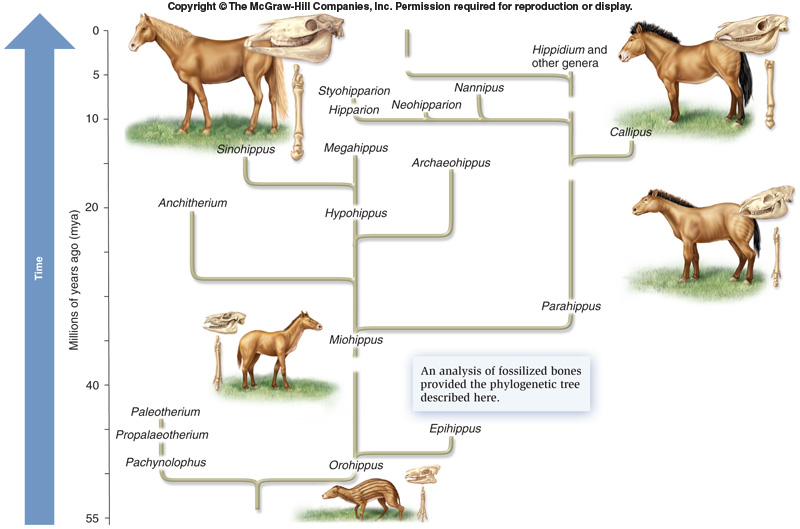
Evolution is a blind process of chance mutation where an advantageous change may get carried over into future generations and become the norm throughout a species. Consequently, you have to look at fossils with the right mindset. Animals and plants aren't 'trying' to improve. Nor are living things aiming towards some perfect design. Consequently, there are blind alleys where a species doesn't make it. The path from ancestral horse to modern horse isn't a linear progression of species getting ever bigger as some older text books erroneously show, like here:

The true picture is rather more complicated. The evolution of the horse is a story of successes and failures. It isn't a simple linear progression towards an ideal and so the simplistic idea of a chain and missing links doesn't hold up. Here's a more accurate diagram:

Secondly, as I said, some of the 'missing links' have been found. It's just that the hardcore Creation lobby simply chooses to ignore them or they simply don't know about them because they don't read Evolutionist 'propaganda' i.e. properly researched scientific papers. If you want missing links, they are there in abundance. Take Tiktaalik roseae for example. Tiktaalik was something like a crocodile and something like a fish, having features of both. Tiktaalik represents a transitional form; although it had gills rather than lungs, the fossils show clearly that it had bony 'hands' that evolved to allow it to haul itself along on land. and, when compared with the fossils of creatures like Panderichthys and Acanthostega, we can see a clear development of form from fin to foot. Not every step - if you'll pardon the pun - is there yet but there's is evidence of a slow and steady change.

a reconstruction of Tiktaalik and a cast of its fossil


We also find transitional forms in terms of animal behaviour too. As you doubtless know, hermit crabs don't have shells of their own and, instead, inhabit the discarded shells of sea snails such as whelks and winkles etc.. The earliest identifiable crab fossils are found in the Jurassic Era, some 145-200 million years ago and, at that time, one of the most prolific kinds of mollusc in the sea were the ammonites; a now extinct order of animals related to modern day nautilus and octopus. And guess what? Hermit crabs used their shells too. We have the fossils.


I enjoy intelligent debate. So I address these questions to the Creationist movement: Why do fossils exist of crabs using the shells of extinct marine animals? Surely if the world is only 5000 years old then there would still be ammonites in the sea and hermit crabs wouldn't have needed to migrate to sea snail shells. And why would God create hundreds of species of ammonite and then wipe them all out? And how? Surely 'the flood' cannot be blamed as we still have many species of crab and fish. The ammonites couldn't have drowned could they? Not like whales can.

Source: Julia Whitty at Deep Blue Home. My thanks to the lovely Dr Helen Scales for making me aware of this.